71% of UX professionals confirm AI now shapes core design workflows, yet 88% of users abandon apps with poor UX. While AI accelerates feature development, startups that prioritize human-centered UX strategy achieve 3x faster adoption and 40% higher retention. This guide reveals how to bridge the AI-human gap—transforming raw technology into genuine user delight.
The AI Paradox: More Tech, Less Satisfaction?
Why UX Strategy Matters Now
- Personalization Gap: 65% of users demand tailored experiences, yet 52% say AI feels “impersonal.”
- Ethical Risks: 68% of apps fail accessibility checks, risking legal penalties
- Business Impact: AI-driven UX increases engagement by 40% and retention by 50% when strategically implemented.
“AI doesn’t replace designers—it amplifies human creativity. Winners blend vision with algorithmic precision.”
5 Pillars of AI-UX Success
1. Hyper-Personalization Engines
Beyond Basic Recommendations:
- Predictive UI: Apps like Spotify rearrange menus based on time-of-day usage patterns (e.g., workout playlists at 6 AM)
Dynamic Microcopy: ChatGPT-4 rewrites button text in real-time (e.g., “Buy now”  “Get your limited edition”)
- Tools: Adobe Firefly (generates UI variants), Dynamic Yield (behavioral triggers)
Impact: 40% higher retention in personalized flows
2. Ethical Guardrails for AI
Bias Prevention Framework:

Critical Actions:
- Run sentiment analysis with Claude. ai to flag exclusionary language
- Auto-test color contrast/WCAG compliance via Figma plugins
- Case Study: Google faced backlash for biased image recognition—now uses 3-layer ethics checks
3. Emotion-Aware Interfaces
2025’s Game-Changer:
- Behavioral Signals: Scroll speed, tap pressure, or camera-based mood detection
- Real-Time Adaptation: Fitness apps switch to “recovery mode” when detecting stress via wearables
- Tools: Affectiva (facial recognition), IBM Watson Tone Analyzer
Impact: 62% error reduction in senior healthcare apps
4. AI-Augmented Design Workflows
Efficiency Revolution:

Key Insight: 47% of designers report higher job satisfaction using AI tools
5. Seamless Human-AI Handoffs
When to Automate vs. Humanize:
IF high-risk task (e.g., medical diagnosis): > HUMAN
ELSE IF repetitive task (e.g., form filling): > AI
Spotify’s Model:
- AI suggests playlists Humans curate mood-based collections
- Result: 30% faster playlist creation + 15% user satisfaction increase
AI-UX Cost Efficiency Calculator

Explore Our AI-UX Portfolio
FAQs
Q: Can AI replace UX designers?
A: No—but it changes roles:
- AI Handles: Wireframing, usability testing, data synthesis
- Humans Focus: Ethics, emotional resonance, strategic vision
“Content designers are essential for contextual judgment—AI lacks real-world awareness.”
Q: How to balance personalization with privacy?
A: Adopt the 3-Tier Framework:
- Transparency: Explain data use plainly
- Opt-in Control: Let users toggle AI features
- Anonymization: Strip identifiers from behavioral data
Q: Which AI tools best accelerate UX research?
A: Top 3 for startups:
- Hotjar AI: Analyzes session recordings for friction points
- Notion AI: Summarizes user interviews
- Dovetail: Auto-themes qualitative feedback
Q: What’s the biggest AI-UX risk in 2025?
A: “Shallow “UX”—Over-reliance on AI without:
- Deep user empathy
- Systems thinking
- Ethical accountability
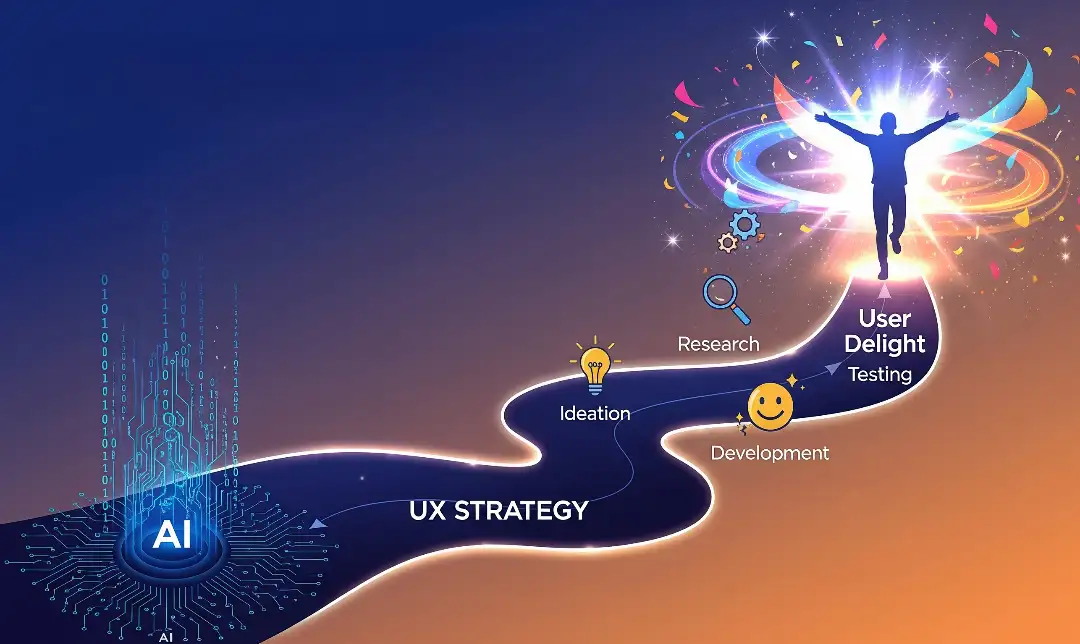
Strategy Checklist: From AI to Delight
- Map high-value personalization points (e.g., onboarding)
- Implement bias audits for all AI outputs
- Design emotion-triggered fallback states (e.g., stress simplified UI)
- Integrate AI tools into Figma/Adobe workflows
- Establish human-AI handoff protocols
Ready to transform AI into delight?
“The best AI experiences feel invisible—solving problems before users articulate them.”






Leave a Comment